
Ever googled your own name? What comes up might matter more than you’d think. When it comes to building a professional online presence, employers, clients, and business contacts are usually checking you out online long before they ever meet you face to face. By the time you do shake hands, there’s a good chance they’ve already formed an opinion based on what they found.
Here’s the good news, though: building a professional online presence doesn’t mean living on every app or posting around the clock. It really comes down to one thing — putting an honest, clear version of yourself out there, one that actually reflects your real skills and what you bring to the table.
Doesn’t matter if you’re still in school, job hunting, freelancing, or running your own small business. A few small, practical habits are really all it takes to start building a professional online presence that people actually notice.
What Does “Professional Online Presence” Actually Mean?
Simply put, it’s about how you show up online when it comes to work or business stuff. At the end of the day, the goal is straightforward: make it simple for anyone to get a quick, clear sense of your skills, interests, background, and where you’re aiming to go in your career.
Why Does Having a Professional Online Presence Even Matter?
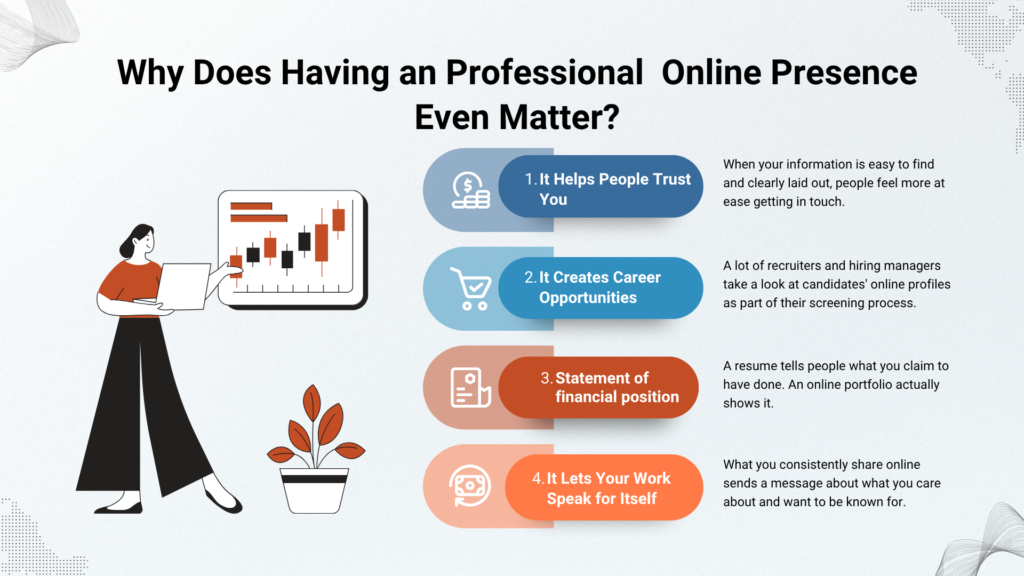
These days, checking someone out online usually comes before picking up the phone to call them. A well-built online presence can be what separates a great first impression from a missed chance entirely.
1. It Helps People Trust You
When your information is easy to find and clearly laid out, people feel more at ease getting in touch. But if your online presence looks messy or out of date, it can plant small doubts without anyone even realizing it.
2. It Creates Career Opportunities
A lot of recruiters and hiring managers take a look at candidates’ online profiles as part of their screening process. A strong digital presence can reinforce what’s already on your resume, and sometimes reveal even more than that.
3. It Lets Your Work Speak for Itself
A resume tells people what you claim to have done. An online portfolio actually shows it.
That might include things like:
- Projects you’ve completed
- Certificates you’ve earned
- Writing samples
- Design work
- Presentations
- Case studies
- Past roles
- Notable achievements
4. It Shapes Your Personal Brand
What you consistently share online sends a message about what you care about and want to be known for.
Someone who regularly posts about SEO, content strategy, and digital marketing, for example, will naturally start being associated with that space over time.
1. Google Yourself First
The simplest starting point is to search your own name and see what comes up.
While you’re looking, ask yourself:
- Which profiles show up first?
- Do the results actually belong to you?
- Are there old, forgotten accounts still floating around?
- Is anything outdated or no longer accurate?
- Does the overall picture look professional?
This gives you a rough idea of what a stranger, or a potential employer, would see if they looked you up today.
2. Set Up a Strong Professional Profile
A well-maintained networking profile often becomes the backbone of your online identity.
Make sure it includes:
- A clear, recent profile photo
- Your current role or the field you’re focused on
- A brief professional summary
- Your education
- Key skills
- Work experience
- Relevant projects
- Certifications
- Any notable achievements
Try not to leave any sections looking incomplete. And if you’re a student who hasn’t built up much work experience yet, that’s fine — just lean on your education, relevant coursework, internships, projects, and volunteer work to fill things out instead.
3. Building an Online Portfolio
A portfolio works especially well if your skills can be shown, not just described.
This applies to fields like:
- Graphic design
- Content writing
- Digital marketing
- Web development
- Photography
- Video editing
- Programming
- Copywriting
- Data analysis
4. Keep Everything Consistent
Consistency is what makes your online identity easy to recognize and trust.
Try to keep the following aligned across every platform:
- Your name
- Your professional title
- Your profile photo
- A short bio or introduction
- Your core skills
- Your contact details
Say your main focus is digital marketing — you wouldn’t want one profile calling you a designer and another calling you a developer, unless that’s genuinely true of your work. Whatever you list should add up to one clear, consistent picture of the direction you’re heading in.
5. Share Content That’s Actually Useful
You don’t need to turn into a full-time content creator to have a presence worth noticing.
Every so often, share something useful and relevant to your field, such as:
- Insights from your industry
- Lessons you picked up from a recent project
- Practical tips
- A recent achievement or milestone
- A course or certification you just completed
- A piece of your own work
The point isn’t to chase likes. It’s to show, in small ways, that you know what you’re talking about.
6. Find the Right Balance Between Personal and Professional
Showing some personality online isn’t a bad thing at all. People tend to connect more easily with someone who feels real rather than robotic.
That said, it helps to pause before hitting “post.”
A useful question to ask yourself: would I be okay with a future employer, client, or professor seeing this?
This doesn’t mean your online presence has to be stiff or overly formal. It just means being a little more deliberate about what you choose to make public.
7. Tighten Up Your Privacy
A professional online presence doesn’t require putting your whole life on display.
Go through your privacy settings from time to time and decide what should stay public versus private.
Steer clear of publicly posting things like:
- ID or identification details
- Personal phone numbers or addresses
- Financial information
- Passwords
- Your exact daily schedule
- Private or sensitive documents
Common Mistakes Worth Avoiding
There are a handful of habits that quietly damage your professional online presence more than anything else:
- Picking a username that just doesn’t come across as professional
- Leaving your profile sitting half-done
- Keeping outdated or inaccurate information up
- Claiming credit for work that isn’t actually yours
- Using a blurry or low-quality profile picture
- Skipping over your privacy settings entirely
- Posting information that really should stay private
- Building a profile once and forgetting it exists after that
- Sharing something controversial without stopping to think it through
- Chasing a “perfect” image instead of just being genuine
Avoiding these is one of the easiest ways to protect a professional online presence you’ve worked hard to build. To know more:
https://www.javaassignmenthelp.com/blog/category/programming/
How Students Can Get Started
You don’t need years of work experience to start building a professional online presence.
Just begin with a solid profile, then build it out gradually with things like:
- College projects
- Internships
- Certifications
- Academic accomplishments
- Volunteer work
- Skills you’ve developed
- Freelance gigs
- Personal projects
A student interested in digital marketing, for example, could put together a small portfolio featuring a couple of sample blog posts, some social media graphics, an SEO project, and a campaign concept or two — building a professional online presence one piece at a time.
Conclusion
Look, building up a solid professional online presence takes time — and that’s totally normal. You don’t need some fancy website, a huge follower count, or a resume packed with achievements just to get going.
Start with the basics. Google yourself, clean up any old stuff that doesn’t fit anymore, put together a couple of decent professional profiles, let your work show what you’re capable of, and share things that actually feel like you.
At the end of the day, just be real and stay consistent about it. People — employers, clients, whoever — should be able to look you up and quickly get who you are and what you’re good at, without having to hunt around for it.
Since so many people size you up online before ever meeting you face to face, getting a handle on your digital presence is honestly just a smart thing to do for whatever’s next in your career.
Frequently Asked Questions
What is a professional online presence?
Basically, it’s how you show off your skills, background, interests, and professional identity across the internet — through your profiles, portfolios, websites, and any other public info connected to your name.
Not sure where to start building your Professional Online Presence as a student?
Kick things off with a professional profile — that’s really all you need at first. From there, just keep adding: college projects, internships, a small portfolio, certifications, whatever content fits the field you’re chasing.
Do you actually need a personal website for a strong Professional Online Presence?
It’s not a must-have, but honestly it makes life easier. Instead of your stuff being scattered across five different platforms, you’ve got one place where your projects, skills, experience, and contact info all live together.
How do you make your Professional Online Presence actually look professional?
Keep the info accurate, use a photo that’s recent and clear (not that blurry one from three years ago), write an intro that sounds like an actual person, put your best work and skills where people will see them first, and don’t hide your contact info — make it easy to find.
